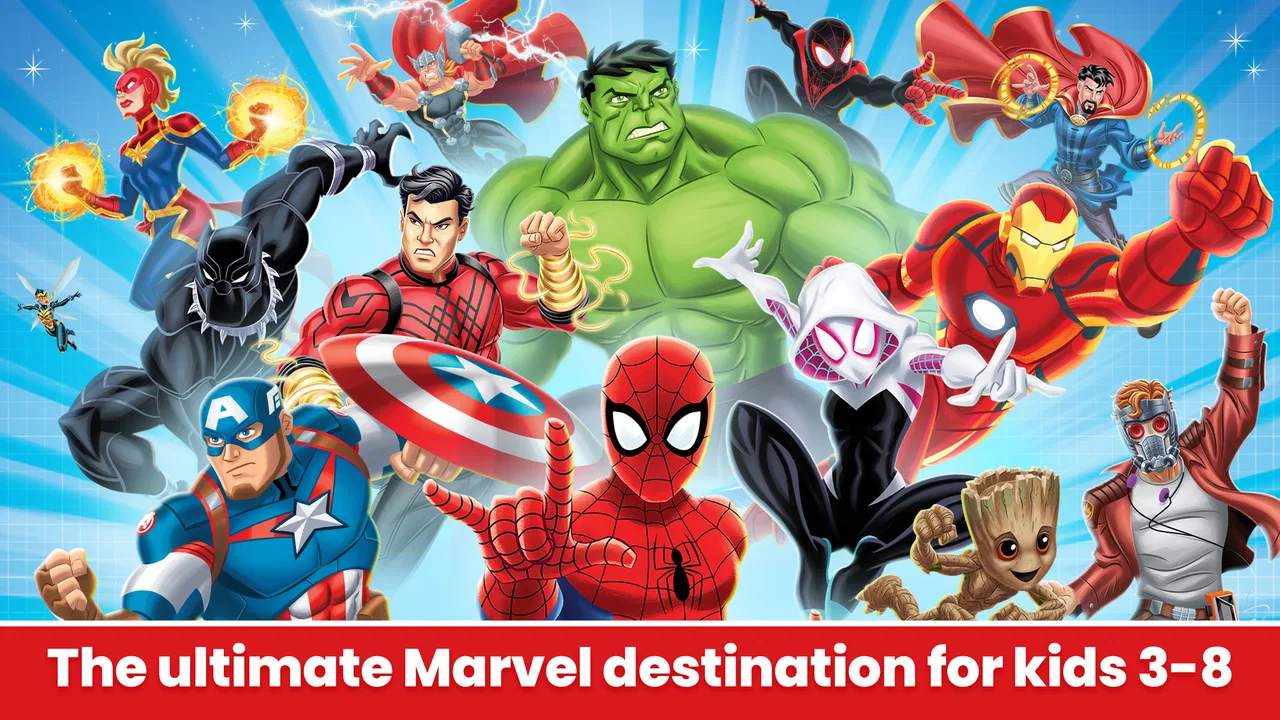
Marvel HQ: Kids Super Hero Fun
- 4.1
- Rating
- 10.00M
- Installs
- Free
- Price

 Analysis by App-foxy
I approached Marvel HQ: Kids Super Hero Fun less like a collection of superhero clips and more like a guided play space for young Marvel fans. That distinction matters. The game is aimed at children from three to eight, so its success depends on whether a child can explore without constant adult help, while still finding enough variety to stay interested after the first visit.
Developed by StoryToys, this free educational game places Marvel characters at the center of activities designed for early learners. It has an Everyone age rating, and its audience is quite specific: children who already enjoy superhero stories and want a safe, simple way to spend time with that world. My overall impression is positive, but I would treat it as a themed learning-and-play app rather than a complete replacement for broader educational software.
Why the guided Marvel world is the main strength
The most important capability here is the way the app gives children a recognizable setting in which to explore. Instead of asking a young player to understand an unfamiliar interface first, it uses the appeal of Marvel heroes as the starting point. For a child, that can make an ordinary matching, drawing, puzzle, or discovery activity feel immediately meaningful.
You May Also Like

 Blood Strike: 2.5 Anniversary
Blood Strike’s Loadouts Turn Every Drop Into a Tactical Gamble
A close look at Blood Strike’s custom loadouts: how fast access to signature weapons reshapes its battle royale rhythm, rewards preparation, and narrows the gap between fights.

 Pandora - Music & Podcasts
Pandora’s Music Is Easy to Start, but Harder to Recover
Pandora’s strength is its low-effort path from a seed to a station. Its weak spot is how much confidence it asks you to place in connection, setup, and quiet recovery.

 8 Ball Pool
 Is Built on Rivalries, Rematches, and Routine
A close look at the rivalries, rematches, shared routines, and unanswered safety questions that turn a quick pool match into a persistent mobile community.

 Samsung Music
’s Quiet Strength Is Playing What You Already Own
Its reach comes less from spectacle than from dependable access to a personal library. That simplicity is both the app’s strongest retention engine and its ceiling.

 AccuWeather: Weather Radar
AccuWeather Review: A Quick, Clear Forecast for Everyday Decisions
For everyday plans, the best forecast is the one you can understand quickly. AccuWeather makes rain timing, radar, and local conditions easy to act on, with a few trade-offs.

 Hill Climb Racing
Why Hill Climb Racing Still Turns Crashes Into One More Run
A tiny car, a bumpy hill and one more upgrade: Hill Climb Racing keeps resurfacing because its simple chaos makes every near-miss feel personal.
More From Our News Desk



In practice, the superhero theme does more than decorate the screen. It gives parents a useful way to invite a child into an activity: “Let’s see what is happening at Marvel HQ” is often more appealing than “Let’s do another learning game.” That small difference can help with transitions, especially when a child is tired, waiting, or reluctant to begin a quiet activity.
I also like that the experience is not presented as a competitive action game. Young children who love Spider-Man, the Avengers, or other Marvel characters may not yet be ready for complex controls, fast reactions, or difficult rules. A calmer hub built around exploration is a better fit for the stated age range than a game that expects precise timing or advanced reading.
The educational label should still be understood in the right way. This is learning through themed interaction, not a structured school curriculum. I would use it to support attention, recognition, creativity, and simple problem-solving, but not as the only app on a child’s tablet. Its strongest educational effect comes when an adult occasionally talks about what the child is doing instead of leaving the screen to carry the entire learning experience.
What a child actually does during a session
The basic flow is easy to understand: a child enters the Marvel setting, chooses an activity or area that catches their attention, and interacts with content using simple touch controls. That straightforward structure is important for preschool users. They can often learn by tapping and trying rather than reading instructions, which reduces the need for a parent to translate every screen.
For younger children, I would begin by sitting beside them for the first session. Not because the controls are necessarily difficult, but because a child may tap through an introduction, open a different activity by accident, or become unsure about what to do next. Once the route is familiar, the child can usually make more independent choices.
One useful approach is to let the child choose the hero-themed activity first, then ask a simple question about it afterward. “Which character did you pick?” or “What did you have to find?” turns passive tapping into a short conversation. This is a more realistic way to get educational value from the app than expecting it to teach a complete concept without adult involvement.
The experience is also better suited to short visits than to a long, uninterrupted session. A child may enjoy returning to a familiar activity, but the appeal of a character-based hub can fade if it becomes the default entertainment for every free moment. I found it more effective as one option in a daily rotation that includes books, physical play, drawing, and non-screen games.
A realistic everyday use case
Imagine a child who is three or four years old waiting quietly while a parent finishes an appointment or prepares dinner. The parent can open the game, choose a comfortable activity, and stay close enough to help if needed. The child gets a familiar Marvel setting and a manageable task, while the adult avoids handing over a complicated game designed for older players.
For an older child in the target range, the same situation can work differently. A six- or seven-year-old may be able to navigate more independently and return to preferred activities without being shown every step. I would still set a clear stopping point before opening the app, because the excitement of recognizable heroes can make “one more activity” tempting.
Another good use is shared play between a child and a younger sibling. The older child can explain what is happening, while the younger one experiments with the touch interactions. This does not turn the app into a multiplayer game, but it can make the screen time more social and give the older child a chance to practice patience and communication.
Where it differs from ordinary educational games
Many early-learning apps lead with letters, numbers, colors, or shapes and add a theme afterward. Marvel HQ takes the opposite route: the characters and universe are the invitation, while the learning activities sit inside that setting. That makes it more attractive to a child who ignores plain educational software, but potentially less suitable for a parent looking for a clearly organized lesson sequence.
Compared with open-ended drawing apps, it offers more direction and a stronger imaginative frame. Compared with action games based on superheroes, it is more approachable for preschoolers because it does not rely on combat skill or fast reflexes. Compared with a general children’s video app, it asks the child to interact rather than simply watch, which is a meaningful advantage when the goal is active engagement.
The trade-off is focus. A dedicated alphabet or early-math app may provide clearer progress through a specific subject. A physical Marvel toy may offer richer pretend play without a screen. I would choose this game when the child’s motivation is the Marvel world itself, not when I need a complete, measurable learning program.
How the free entry point affects the experience
The game is free to install, which makes it easy to test whether a child responds to the theme before a family commits money. That is valuable here because interest in Marvel can vary sharply from child to child. One child may be absorbed immediately, while another may prefer animals, vehicles, or a non-fiction learning app.
There are in-app purchases ranging from $6.99 to $39.99 per item. I would pay close attention to the purchase flow before handing the device over. The free starting point is useful, but families should decide in advance whether they are comfortable buying additional content. A child who sees locked areas or activities may naturally ask for them, so this is worth discussing with younger users in simple terms.
My practical advice is to explore the free portion together first. Watch how long the child stays engaged, whether they can navigate comfortably, and whether the activities fit the kind of play you want to encourage. If the child loses interest quickly, spending more will not solve the underlying mismatch. If the game becomes a genuinely useful part of a family’s short-session routine, a parent can then make a deliberate decision rather than an impulsive one.
The purchase range also changes the value calculation for different households. For a Marvel-focused child who returns often, extra content may feel more worthwhile than it would for a child who only wants a familiar character for a few minutes. I would not view paid additions as essential to judging the app; the important question is whether the free experience already supports the child’s interest and independence.
What parents should watch during play
My first recommendation is to observe the child’s behavior rather than judge the app from the theme alone. Does the child make choices, solve small problems, and talk about what they see? Or do they simply tap quickly until something changes? The answer tells you whether the app is functioning as active play for that child.
It also helps to use the game as a starting point for offline activities. After a session, a child might draw a hero, invent a rescue story with toys, or sort characters by color or costume. These extensions do not require special features inside the app, and they prevent the digital version of Marvel from becoming the only form of imaginative play available.
For children near the younger end of the audience, keep expectations modest. A three-year-old may enjoy the characters and touch response without following a longer sequence. An older child may want more challenge than the same activity provides. That age spread is one of the app’s practical limitations: a design that feels welcoming to a preschooler can seem repetitive to a confident reader.
I would also avoid using it as a reward for every difficult moment. The superhero theme is powerful motivation, but if it becomes the only reliable way to calm a child, the family may end up depending on the screen rather than building a wider set of routines. Used in moderation, it works better as a planned activity than as an automatic solution.
Where the experience may feel limited
The biggest limitation is that the Marvel identity can carry the experience only so far. Children who are already familiar with the characters may enjoy recognizing them, but recognition does not guarantee sustained challenge. Once the novelty settles, some children will need new activities, more complex puzzles, or a clearer sense of progression.
That is why I would skip this game if my main goal were systematic reading instruction, detailed number practice, or a carefully staged curriculum. There are better choices for those needs. I would also look elsewhere for an older child who wants a traditional superhero adventure with deeper storytelling, strategy, or action. This game is intentionally aimed at younger users, and its simplicity is both its welcome feature and its ceiling.
Another consideration is the child’s relationship with branded entertainment. Some families are happy for a favorite franchise to encourage learning activities; others prefer apps that are less tied to characters and merchandise. Neither approach is automatically better. In my view, the branding is helpful when it gets an otherwise hesitant child involved, but it is unnecessary for families seeking a neutral educational environment.
The app’s popularity suggests that it has reached a substantial audience: it has an average rating of 4.4 from around 8.7 thousand ratings and more than 10 million installs. Those figures make it easier to see why parents may encounter it, but they should not replace watching how a particular child responds. A popular children’s game can still be the wrong fit for a child who needs slower pacing, less stimulation, or a different subject.
Who gets the most from Marvel HQ
I think the strongest audience is children from three to eight who already enjoy Marvel and benefit from a gentle, touch-friendly way to explore that interest. It is especially useful for families looking for a short educational activity that feels like play rather than a lesson. The Everyone rating also makes it a natural candidate for shared family use, with an adult nearby during the first few visits.
It is less compelling for children who do not recognize or care about Marvel characters. In that case, the central motivation disappears, and a simpler non-branded learning game may hold attention better. I would also hesitate to choose it as the primary app for a child who is ready for advanced reading, sustained strategy, or measurable subject progression.
StoryToys has positioned the game as a destination for young Marvel fans, and that focus is clear in use. The release date was May 16, 2023, so I see it as a relatively recent option for families comparing children’s apps, but the more important question is still practical: does the child engage with the activities, or only with the logo and characters?
My recommendation is to try the free experience with the child present, set a short session limit, and ask them to explain what they did afterward. If they can navigate, make choices, and carry the superhero play into conversation or offline imagination, the app is doing something worthwhile. If they become frustrated, demand paid content immediately, or lose interest after the first novelty, I would move on without feeling that the child needs more screen time.
In the end, Marvel HQ: Kids Super Hero Fun works best as a themed doorway into early learning and imaginative play. Its greatest strength is not that it turns Marvel into a formal course; it is that familiar heroes can make a young child willing to explore. That motivational bridge is the real reason to try it, while the free entry point lets parents judge the fit before spending more. For the right Marvel-loving child, it is a friendly addition to a balanced routine. For everyone else, a focused educational app, a book, or hands-on play may be the better choice.
FAQs for Marvel HQ: Kids Super Hero Fun
01What is Marvel HQ: Kids Super Hero Fun?
Marvel HQ: Kids Super Hero Fun is an interactive app designed for children, offering a safe and engaging environment to explore the Marvel Universe. It features games, videos, and activities centered around popular Marvel superheroes like Spider-Man, Iron Man, and the Avengers. The app aims to entertain while providing educational content for young fans.
02Is Marvel HQ: Kids Super Hero Fun free to download and use?
Yes, Marvel HQ: Kids Super Hero Fun is free to download on both Android and iOS platforms. However, some features within the app may require in-app purchases or subscriptions to unlock additional content. It’s advisable for parents to review these options to ensure they align with their preferences before allowing children access.
03Is the content in Marvel HQ: Kids Super Hero Fun appropriate for all age groups?
The app is specifically designed for children, focusing on age-appropriate content that is safe for younger audiences. It includes parental controls to monitor and limit access to certain sections if needed. This ensures that children can enjoy the app’s offerings without exposure to unsuitable material.
04Can Marvel HQ: Kids Super Hero Fun be used offline?
Marvel HQ: Kids Super Hero Fun requires an internet connection for initial download and to access most of its content, including videos and updates. However, some games or activities may be available offline once they have been downloaded. It’s best to check specific sections for offline capabilities, especially if planning to use the app without internet access.
05Does Marvel HQ: Kids Super Hero Fun feature multiplayer options?
Currently, Marvel HQ: Kids Super Hero Fun is designed for single-player use, focusing on individual interaction with games and activities. This ensures a personalized experience for each child, although they can still share their progress or favorite features with friends in a non-competitive manner. Multiplayer functionalities may be considered for future updates.
Pros
- Engaging superhero-themed games.
- Educational content for kids.
- User-friendly interface.
- Regular updates with new content.
- Safe environment for children.
Cons
- Limited content for older kids.
- Requires internet connection.
- In-app purchases present.
- Some games may be repetitive.
- Limited parental controls.

Marvel HQ: Kids Super Hero Fun
Gallery